In Huizenga's hands, Glenn and Wendy are achieving Shulz-ian levels of identifiable reality. What I mean is that rather than drawn characters in books by Huizenga, there's a sense that they actually do exist, and the artist is just revealing slices of their daily lives to the reader in an almost documentary fashion. Now, I don't actually believe that Glenn and Wendy exist in the "real world," (or that I'll have a chance to meet them one day). Rather, I've pretty much accepted the real-ness of the world in which these characters live.
I suppose this is something the artist primarily effects, but there's also an act of transferance that takes place on the part of the reader. (And as I described in an earlier post, George Herriman achieved this with his Krazy Kat and Ignatz, too.)
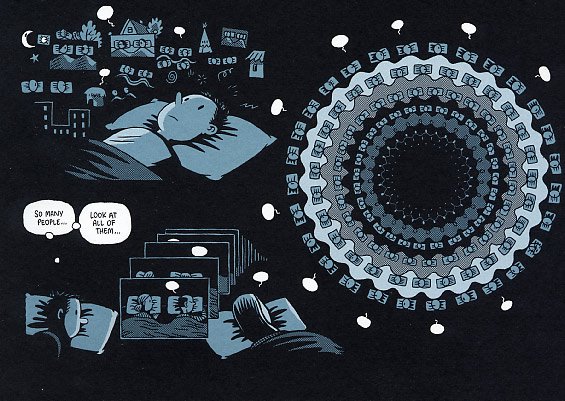
There are some nice panels in Ganges #1. In the final story, Glenn lies awake in bed beside his partner, thinking about the countless other people on earth who might be doing the same thing. While not a particularly profound idea, it yields a profound image: multiple heads on pillows precisely arrayed, resembling the rose window of a gothic cathedral.
For readers interested in more Huizenga, here's a short bibliography of collected material:
Drawn and Quarterly Showcase, Book One, (Drawn and Quarterly, 2003); contains three stories: "Glenn Ganges," "28th Street," and "The Curse."
Kramers Ergot 5, (Gingko Press, 2004), contains Huizenga's intelligent novella (in color!) titled Jeepers Jacobs.
No comments:
Post a Comment